
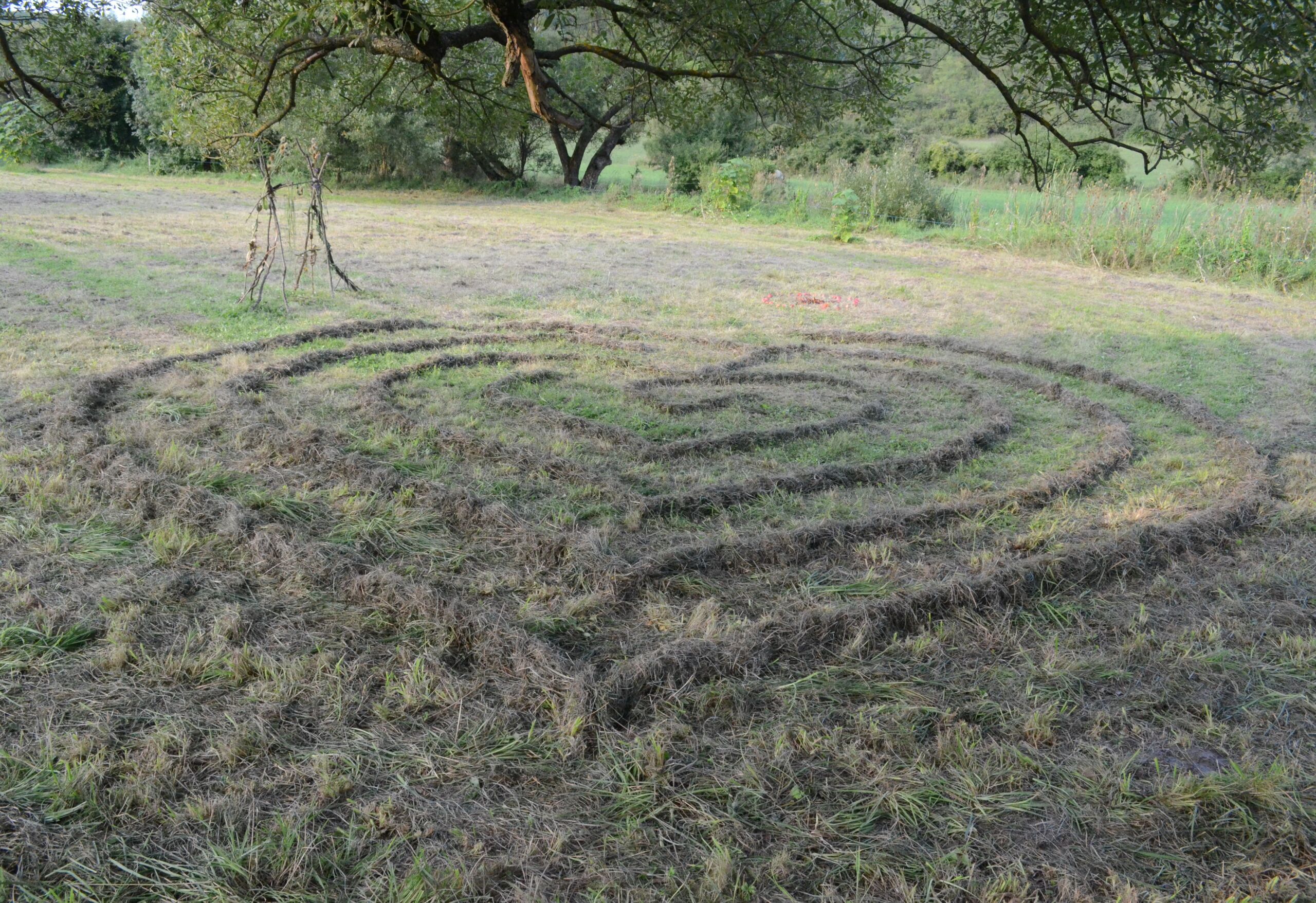
Just over a year ago, my colleague, other participants and I attended the first session of the joint training series organised by Tandem and the Élményakadémia, called Re:Connection, in Gombaszög.
Representing Tandem, Krisztina Molnár and Péter Halász demonstrated how they use the labyrinth as a tool in their own training exercises. In addition, through various Bodyway exercises, we were able to deepen our self-awareness and also focus on our mental wellbeing – which, for a helping professional, is no longer a luxury but, I hope, a professional duty.
Well, when I set out, I certainly had no idea how many layers of inner exploration I would traverse, or how many different emotions would surface within me.
I walked through the labyrinth – built from stones we had carried with our own hands, including stones from the monastery itself – several times a day. Sometimes I went alone, sometimes with others. Laughing, crying, turning my attention inwards, supported by psychodramatic techniques, following music coaxed from musical instruments, barefoot, blindfolded.
Whatever other exercises we did – for example, one day we were able to retrace our own life journeys, at the end of which our own death certainly awaited us, and shortly afterwards we experienced a deeply moving yet highly enlightening process of rebirth – we always returned to the labyrinth.
Where it is impossible to get lost
When we were instructed to feel free to experiment with walking the labyrinth, at the encouragement of Kriszta – who is also a psychodrama facilitator – I sought help with an earlier, unresolved grieving process of mine.
As I made my way towards the centre of the labyrinth, I saw my lost loved one all the way through. At the centre, unlike in reality, I said goodbye to them, and then, accompanied by their gaze, I finally walked out.
And it was true, just as they had said: you cannot get lost in the labyrinth.
This experience marked a huge breakthrough in how I was processing my grief. My struggle with this loss, and my coming to terms with it, found a peace I had never experienced before.
At the time, I wouldn’t have been able to put into words exactly what had happened. I just felt that something had shifted within me. Something that hadn’t found its way there before.
Today, I see this as one of the labyrinth’s most important symbols: the path leading to the centre often leads to our own innermost world. To a place where unspoken questions, losses, setbacks and answers can all find a home.
A path that always leads back
A labyrinth is not a maze; it contains no dead ends, no misleading junctions, no wrong turns. There is a single path leading inwards to the centre, and the same path leads out again.
However, this does not mean that it is easy to walk through.
One of the most important questions about the labyrinth is precisely this: shall we enter?
Shall we dare to set off inwards? To encounter what awaits us there? To allow ourselves to undergo transformation, to experience realisations and emotions?
The ancient symbol of walking the labyrinth represents this journey: the distancing from the outside world, the journey itself, and then the return. As we move towards the centre, we are symbolically drawing closer to our own spiritual and mental centre. At the centre, we can pause, observe, rest, and then, on the path leading outwards, return to the world.
Put another way, perhaps more simply: we set out towards ourselves, and hopefully return a little different.
The labyrinth is also a form of walking meditation. It offers an opportunity to step away from the hustle and bustle of everyday life, to slow down, quiet our minds, and allow the thoughts, feelings and questions swirling within us to find space.
You don’t have to navigate it perfectly. There’s no such thing as a ‘good’ or ‘bad’ performance. There are no expectations about what we should experience.
But there is an intention.
And perhaps this is one of the most important things we take away with us.
Answers in the center?
It’s worth entering the labyrinth with a specific question in mind. Not because it will hand out ready-made answers, but because the question helps to direct our attention towards a particular life situation, problem or inner issue.
The labyrinth is not a dogma. There is no single correct interpretation, nor is there a single prescribed way to walk through it. It can be a simple walk, a meditation, a spiritual experience, a process of self-discovery, or even a personal ritual.
What happens within it can be different for everyone. For some, a thought may arise. For others, a feeling. A memory. An image. A realisation. Or simply a little peace.
And for some, something happens in the labyrinth that they hadn’t even expected.
The feelings, images and thoughts that arise whilst walking the labyrinth do not necessarily make sense straight away. Sometimes a realisation only comes days or weeks later. It may also be that nothing in particular happens at the centre – and that’s fine too.
It’s enough simply to be present.
Building the first labyrinth
On my return, I knew I’d like to try it out in many other places, but I was really unsure about where I could set up a labyrinth.
I didn’t feel I had enough experience, nor did I feel I’d done enough research on the subject.
Yet the first time I built a labyrinth came around quite quickly. That very summer, a few weeks after the retreat in Gombaszög, we laid out the first labyrinth at the ALAP! Camp, organised for children in state care.
The idea had been preceded by many discussions amongst the trainers. And we were all right. Both those who wanted it and those who were wary of it. In the end, we went for it.
At the pagoda at the end of the winding forest path, we laid out a five-circle maze, which we decorated with candles. We laid out resource cards along the path.
The 41 young people arrived in three groups. They had already fallen silent as they walked towards the pagoda.
I was waiting for them there, and I explained that the labyrinth wasn’t a maze: there was only one path leading in, and the same one would lead out. I asked them to go in with the thought of who they would like to become and what they would like to achieve. If they felt unsure, they should draw one of the cards facing downwards.
As they walked out, they were to light a candle.
We’d planned to have a short break after walking the labyrinth, before the evening reflection session. But the young people were so captivated by the labyrinth that they asked us to go straight back to our usual venue for the evening discussion and, after listening to a bit of guitar music, talk through what had happened there.
Several of them came up to me and assured me:
They’d drawn exactly the card they needed.
Forty-one young people left the experience feeling empowered and full of plans for the future.
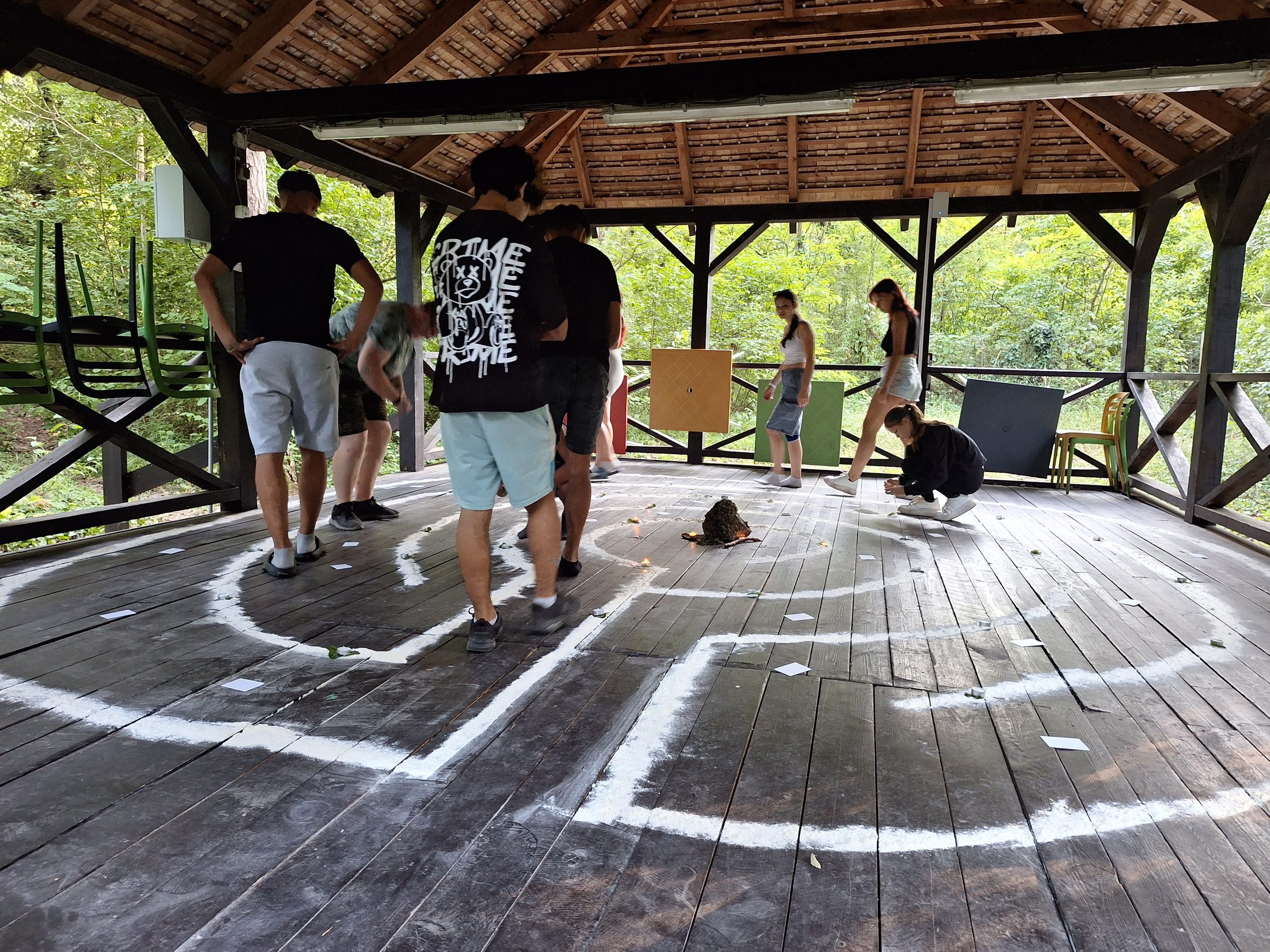
This experience moved me so deeply that ever since, wherever I can, I’ve been building mazes.
I have yet to see one fail to work. I have yet to see one fail to work its magic. I have yet to see one fail to bring calm and a sense of focus.
Child protection specialists have walked the labyrinth with us, as have our own trainer colleagues on our annual retreat; we have even used it at the Bátor Tábor camp with parents whose children live with chronic illnesses.
Yet the labyrinth has always welcomed us, provided space, and then set those walking within it on their way.
Perhaps this is precisely its greatest strength: it does not seek to solve anything for us. It does not tell us what to do. It does not provide ready-made answers: it creates an opportunity for us to hear our own answers.
So that we may encounter our true selves, so that as we move towards the centre we may draw closer to what truly matters, and so that as we walk out, we may see the world in a slightly different light.
Whoever enters here…
So, whoever enters the labyrinth, feel free to let go of all hope. Not because there is no hope. But because perhaps what we need isn’t what we first think it is.
We may not get an answer to the question we came with. We may leave with a different question. We may leave with a feeling, a memory, a tear, a smile, or perhaps a great deal of silence.
If we allow ourselves to be present, to listen, and not to try to control everything that happens at all costs, then we can get closer to ourselves.
And perhaps that is the true gift of this labyrinth: that we emerge from it with answers, with understanding, and with a sense of centre. Or simply one step closer to ourselves.
Will you step inside?